


“Everyone is pinned, as you asked,” said Hiba, who had distributed the welcome packs to each scholar except for one, Daniel, whose envelope she held against her chest. “Here you are, Mr. Perrin,” she said. “Right. Thank you,” said Daniel, out of breath. Hiba turned her attention back to Susan. “The coach will be here in a moment. Do you need to go upstairs and retrieve your bag? You will be going straight to the airport from the Ambassador’s residence.” “Oh yes,” said Susan. “Thank you, Hiba. I’ll be right back.” As Susan walked away from the crowd, she felt as self-conscious as she had the night before, but also a little exhilarated. It felt good to be looked at.
Her mind then changed to practical matters. Her main purpose for being in Washington was to play the hostess the first night, before Daniel had arrived, and to speak briefly that afternoon, before the Ambassador addressed the scholars. Then she was to go straight back to London on her own, taking copies of all of the young Americans’ passports and university acceptance letters to her counterpart from the Home Office at Heathrow Airport before the scholars themselves came through the next day. It all made sense in the planning, but Susan could have just as easily stayed over and taken care of the visas when she landed with the rest of the group. She was suddenly worried that her conversation with Daniel may never resume.
What if Susan’s whole life could be turned upside down by one more night at the Palomar?
Tom approached Daniel. “Right on, Perrin. Sightseeing this morning?” Jonah, standing nearby, turned and interjected, “Perrino! Well played, man. Everyone was wondering where you were. Nice, dude. You’re going to do well in England, man. You’re the type. I can tell.”
Daniel was flustered. “No, I took a walk to the Cathedral. That’s all.”
Sully registered his opinion next. “I think it’s encouraging to see more romantic partnerships between younger men and older women. We’re a long way from Jane Austen, but we still have it in our minds that the right age for a man is his early thirties, after he’s lived a bit, whereas the right age for a woman is barely past puberty. Nowadays, even challenging that paradigm is implying there should be a paradigm, which eventually there will not be, mark my words. But for now, it’s enjoyable to see people break the rules a bit. Test those soft taboos.”
Suddenly feeling on the defensive, Daniel fired back, “there are plenty of examples in history where the woman is older than the man. Respectable people too, or sort of – not Cleopatra, or George Eliot, or someone like that. Disraeli’s wife was twelve years older him, I think. Queen Mary was way older than Philip. Shakespeare’s wife was seven or eight years older, if I remember correctly. Anyway, that’s not the case here. We were just talking. Susan’s…lovely.”
“Ohhhhh!” All three men around Daniel erupted in the kind of taunting, schoolboy laughter men hang onto until middle age, even among liberal elites. Hiba overheard the conversation and smirked at the young men’s reaction. She had never thought about Susan’s love life. But she was a bit perturbed at her boss at that moment. She thought it inappropriate for Susan to disappear all morning dressed up in a black dress and heels and return in an overheated rush with a young man – one of the scholars, no less.
Although she was always respectful to Susan, Hiba sometimes complained about her off the clock. “Susan’s family business caters to hunters, for Christ’s sake,” Hiba complained to one of her girlhood friends, in the East London accent she mostly concealed at work. “It’s going to be illegal soon, yeah. And all dat Home Counties, public school stuff is just nauseatin’, innit?”
Secretly, Hiba imagined how much better she would be at Susan’s job. Susan was a bigger splash in front of people, that was true. She was so British, which was exactly what the Minister wanted for this assignment with the scholars and the Ambassador. She was a public face of and for Western leaders. But Hiba was more methodical, and in the department’s everyday work, which consisted of meetings with education ministers and junior officials from the Middle East, India, Pakistan, and even Africa and the Far East, she thought that her smaller, subdued physical appearance, and most of all her hijab, made a better impression. The still-quiet undercurrent of Hiba’s generation, around the same age as the American students, was that it was people like her who represented the Britain of the future. Such a thought had not yet occurred to people like Susan’s parents.
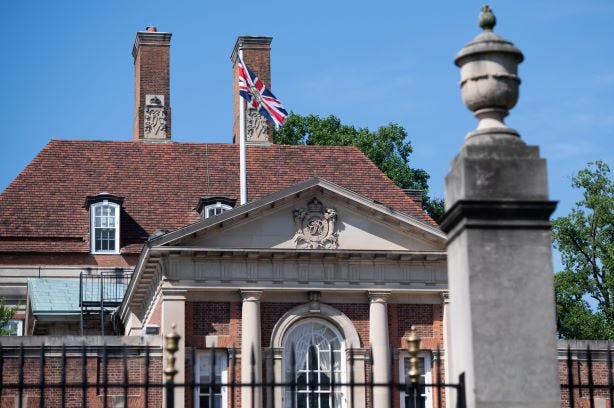
Susan and Hiba descended the steps of the coach first, leading the Americans to the doorstep of the British Ambassador’s residence, a grand red brick estate with lush gardens, including roses still in full bloom on this early autumn occasion. In fact, the weather was nearly summery as the sun reached its peak in the sky. The party was welcomed by the Ambassador himself. His name was Sir David Manners KCMG, a long-time diplomat, and the sort of person Susan had thought she might like to become when she entered the civil service. He was tall and blonde, spoke in a posh, military-style clip, having been recruited for Army intelligence out of Cambridge. As a reward for presiding over the sad transfer of Hong Kong, he was given a knighthood and the brass ring for his final assignment: the U.S.A. Sir David was a protégé of the infamous Enoch Powell, but he had long since denounced the “rivers of blood” language of British nationalism. He was a man of the world now. “Ambassador to the future,” he joked. He was close friends with last Tory Prime Minister, but he liked the current Labour man an awful lot too.
The Ambassador’s wife led the Americans through the back of the residence to the large garden, where there awaited an even larger group of Americans, mostly recipients of two other major scholarship programs. Various dignitaries and guests roamed among them.
Susan realized right away that her black dress was a bad idea. This was an outdoor affair, for God’s sake. The humidity was stifling, and waiters were bearing trays full of Pimms, G&T’s, and champagne. The bottomless glasses of reds and whites would come when they all sat down. Across the garden, Susan spotted Daniel in a group with Tom, Jonah, and Sully. A slim brunette of about forty, of average height, pretty with slightly masculine shoulders, was making her way to the young men. She walked with a confidence characteristic of the well-bred, or at least the well-connected. She stood out in a fuchsia-colored cocktail dress.
“Hello, boys. I’m Ghislaine.”
“Gee-lane?” Tom repeated. “I’ve never heard that name before ma’am, but it is a pleasure to meet you.” He extended his hand. “Tom Mawhinney of the state of Oregon and the United States Marine Corps. You look lovely, by the way, ma’am.”
“It’s gruesome that someone so handsome should care!” the woman fired back. “As for my name, my mother is French. My father is English and he works in the newspaper business. That’s why I’m in America. New York, not Washington. I’m a friend of the Ambassador’s, you see. He wanted to populate the place today with some of the great and the good to give you lot a proper send-off. Not that I’m either, really. But now you know the truth about me, you won’t see me anymore,” she laughed.
They all found her turns of phrase odd, but Daniel also thought them familiar. She turned her attention to Jonah and said, “Anyway, it’s time the tale were told. What do you do and where are you headed?”
“Women’s Studies at University College London,” he told her.
“Good heavens! A man making an academic study of women? Now I know how Joan of Arc felt,” she replied, laughing to herself again.
Daniel had figured out her strange way of talking, but he kept his discovery to himself for now.
She then looked at Sully. “And you?”
“Literature at Edinburgh.”
“It would be such a romantic place if not for the Scots,” she joked. “But stop me if you’ve heard this one before. Haha!” Obviously bored with the company, Ghislaine skipped Daniel and backed up a step to address all four men. “Well it’s all changed now, chappies. You’re on the cusp of a big adventure, but I wonder to myself, could life ever be sane again? I want to tell Sir David about a dear friend of mine. Bon voyage, gentlemen. And congratulations.”
When she was still within earshot, Sully commented, “What the hell was all that about?”
“Smiths lyrics,” Daniel replied. “She was quoting Smiths’ songs. Messing with us for some reason.”
At that moment, Daniel saw Susan, who was standing in a small group of young women gathered around a short man in a medium brown suit with a light blue shirt and dark blue knit tie. He had brown-grey hair and a matching a handlebar mustache. He was holding court in a way that made Daniel think he must be a professor or an author or an inventor of something famous that everyone had heard of but him.
Jonah identified the man as John Freeman. “What a genius. Don’t you know him, Perino? Pulitzer Prize winning columnist at the Washington Post. His work is so timely. So timely!” Daniel shook his head.
“No? Well, he wrote about how we all completely misunderstand Islamic countries and the developing world, and we’re blinded by Hollywood stereotypes and one-off atrocities like the Ayatollah or, you know, the recent stuff…. Anyway, he’s really sounding the alarm against retaliation. Our thoughts are clouded by racialist and mercantilist views of nations and peoples. He says we should all experience life as a Chinese person for a day or two and reset our expectations for the future.”
“Sounds like a bunch of Commie propaganda to me, fellas!” Tom said with a booming laugh. “But hey, whatever. Fight through it. I see one of my academy buddies. Later guys.” Sully was not amused by the burly military man’s remarks. He asked, “Aren’t there any poets here?” Daniel suddenly noticed Sully was wearing some kind of shiny lip gloss. And was that eyeshadow? He had never seen such a thing.
For the next hour, the service staff, dressed in formal livery, brought more drinks and hors d’œuvres. Only they used a different French word, “canapés.” Sully pointed out to Daniel a little band of thirty-something men with crew cuts wearing tan, light grey, and medium blue suits. “CIA,” Sully said. “Or NSA, government guys in sensitive departments. They know we hate them, but they think they’ll stumble on some real elite young patriot in a crowd like this. They’ll probably fall all over themselves to get to our friend Dean the Marine or whatever that Mawhinney’s name is.”
For just an instant, Daniel thought fondly of Tom Cruise sitting in a safe house, writing messages in all the known languages to try and find an arms dealer named Max.
The Ambassador finally ascended the back steps of the residence to welcome the crowd onto the large covered patio. It was here that they hosted luncheons when the weather was fine, a condition interpreted more liberally by the Embassy than most Americans would. On this day, the men’s suit jackets were soaked through the back with perspiration. The women’s hair was frizzing and their deodorant was failing under their sleeveless dresses.
The Ambassador had created the menu himself. It was a tribute to British cuisine, an unsolicited response to the friends and family members of these young Americans, who had endured their jokes all summer about the wretched food that awaited them abroad. The starter was a mulled poached pear and goat cheese salad, with watercress and toasted pecans, followed by an array of three small Hebridean lamb chops plated in a minimalist, modern style with traditional candied carrots, mint peas, and oven roasted rosemary potatoes. Dessert was a summery berry trifle. Daniel found it delicious, but as he ate, he worried about the story of President Zachary Taylor dying from cherries and milk on a hot day. The Ambassador’s meal was much too heavy for an Indian summer midday al fresco experience.
To Daniel’s right was a pale female engineering graduate with acne scars and not-quite brown or blonde hair, best described as plain-colored. They said almost nothing to each other apart from exchanging their undergraduate school credentials, which were both second-tier public universities. To his left and across the other side of the table, Sully had found a new activist-minded cohort of four souls issuing an uninterrupted rumble of jargon, without the aid of any wine or spirits. For his part, with the earlier cocktails and more red wine every time the waitress approached the table, Daniel was stuffed to the gills and completely sloshed by the time Susan came to the microphone.
Susan’s American bra was just about suffocating her as she began to talk, and she had an absurd passing image of herself ripping it off and baring all. Even Bridget Jones would never entertain such an idea. Maybe Eddie from Absolutely Fabulous would. Susan had been told she looked a little like a young Jennifer Saunders.
Once at the microphone, Susan’s task was to recognize various members of committees involved in selection, and giving the scholars an overview of what to expect during the brief immigration interview upon landing in London. The Minister had told her to offer a few tips about the difference between ordinary life in Britain versus the U.S.A., so she mentioned inanities like there are no mixer taps on sinks and you still have to buy a plug separate from electrical appliances sometimes. For the Oxford-bound students she recommended they get to know Blackwell’s bookshop immediately.
She was perfect for the part, exuding official charm.
Daniel did not listen closely to Susan’s words, but he enjoyed seeing her up front. He didn’t know about her uncomfortable underwear, of course, but his inebriated state made him more aware of her figure, which was womanly compared to the still girly look of most of the females his age. Ravishing. Did Susan know someone found her ravishing? Daniel hated pro forma speeches as a rule, but he had a voyeuristic appreciation for them from people he knew and liked. It was if he was in on their joke. He felt privileged to have seen beneath Susan’s public persona already during their impromptu breakfast earlier in the day. Now, drunkenly, he imagined seeing under her dress.
Next, it was the Ambassador’s turn to speak, and he intended to use the occasion to say something significant about the challenges and opportunities facing the Anglo-American alliance. Members of the press were there after all. And it was an open secret that many members of the British media in Washington did double-duty for the intelligence service back home. The Prime Minister was eager to let Sir David be a surrogate for articulating his forward-thinking solutions to global challenges, and the right people were present to disseminate it.
“Thank you very much indeed, Susan,” he began. “You’ve all been asked to wear pins of the American and British flags, and I am pleased to see you doing so. We all know this is a time for particular pride in your flag, as we see moving images of its rising up from smoke and rubble in lower Manhattan and nearby at the Pentagon. The tattered banners of stars and stripes call to mind for students of history the images that inspired the writing of your national anthem. Of course, as an Englishman, I am loathe to remember it was my country firing upon yours that inspired Francis Scott Key’s stirring poem. It is, however, some consolation that the tune was written by an Englishman. If only it was a bit easier to sing!”
At this remark there erupted a small, dutiful outburst of laughter among the Embassy staff. The Ambassador cleared his throat, adjusted his reading glasses, and looked down closely at his notes before continuing. His demeanor had intensified.
“On behalf of her Majesty’s government, I welcome you all here today, and especially the groups of young American scholars, tomorrow’s leaders of this great nation, about to continue or, in some cases, finish, their academic formation in Great Britain. We find ourselves today in a position of unbreakable strength in our partnership. We are better allies than ever before in the cause not only of defending our respective nations, but of promoting values that transcend nationhood itself. Whereas our common ancestors believed in the supranational principles of Christendom, we, the sons and daughters of the Enlightenment…we believe not only in supranational principles, but in suprareligious ones, if I may be permitted the invention of a neologism.”
Sir David reckoned that a little linguistic innovation was the order of the day for an important speech like this. He continued,
“Some of you here wear the uniforms and insignia of your nation’s military branches, as I once did for mine. And we shall soon embark upon new conflicts to which you may be called to serve and to sacrifice. For this reason, to you in particular, but to everyone here present and to the wider world beyond, I want to say a word about our enemy. Most importantly, despite what he says, our enemy fights not for his god, but against his own freedom. As such, he is to be pitied, not hated. He maintains the absurd view that the progress we all enjoy represents the rotten fruit of our wicked toil. We enthusiastically offer him his own abundance from our superabundance, and he attacks us in return as brokers of decadence. The tokens of our vengeance on behalf of our countrymen who have so tragically died, therefore, are hot showers and television sets and myriad choices of things to eat for dinner. We shall civilise our aggressors if we must at the last use our missiles and tanks to do it. They shall one day be so comfortable, as we are, that it would not occur to them to do violence to anyone.”
On this point, the man from the Washington Post was particularly pleased, and when a round of applause began, he led the assembly in a standing ovation. It was going well for the Ambassador. As the applause died down, however, a rumble of chatter and shouts began to creep over the luncheon. It seemed to be coming from outside the embassy walls. Ignoring the noise, the Ambassador picked up where he left off.
“We must now think beyond the thousands of lives already lost. They could have been anyone. Indeed, they were anyone, and no one in particular. They belonged within the democratic world. Or more accurately, they belonged to the democratic world. They wore lounge suits and they wore track suits. They wore dresses, like Susan here. And they wore traditional head scarves, like Hiba there.”
He was proud of himself for double-checking the young civil servant’s name before he began speaking. But as he paused, the roar from outside the compound was now too loud to mistake. There was a protest going on at the gates. Nonetheless, he resumed his speech, increasing the volume of his voice and articulating each word more deliberately.
“The world is our community, and all of us will find our lives changed, mostly for the better…much better… as technology shortens the distance between our communications and our commerce. It will be much easier for the closed-minded to use our own tools of progress against us as weapons of regress. In order to remain free, we must change our laws to ensure that freedom is not abused for the sake of destroying what the heroes of our modern era have built upon the ruins of a decaying and superstitious past.”
The outside noise had become a roar, and the crowd was visibly agitated. Sir David’s aide-de-camp was flicking his wrist in a circle, as a signal to wrap up. Perturbed, the Ambassador skipped the paragraphs about surveillance as a necessary sacrifice, and a passage about how important it would be for elite professionals to be exemplars of trust in international governing bodies. It would not be an oration for the history books after all. He jumped to the end, almost shouting the conclusion.
“This is a moment of the greatest import. The chess board has been overturned. The pieces hang now in the air awaiting their fall to earth. The choice before us is whether to let them settle in a chaotic heap, or seize the opportunity to re-order them for a common victory. We have in our power the means to destroy ourselves or to give everyone else the prosperity we enjoy. Only the moral authority of people like us, thinking beyond old hatreds and prejudices, can ensure not only survival, but flourishing. For this reason, even as the bombs begin to drop, we must lead the way in embracing tolerance as the virtue that undergirds our complex society. Tolerance for America. Tolerance for Britain. Tolerance for our wonderful world. Thank you all very much, and Godspeed.”
Instead of the final ovation the Ambassador had hoped for, and frankly expected, the seated guests stood up as the final syllable boomed through the PA system, and they began to rush through the house towards the front gates on Massachusetts Avenue. Daniel figured he could see at least a hundred people through the iron bars. The two civilian security guards were shouting into walkie-talkies, clearly spooked. Daniel turned around and saw Susan approaching him on his right. On instinct, he held out his hand to her, and she grabbed it, in shock about what to do. Was she in charge? “Perhaps everyone should take off their pins,” she whispered, staring blankly forward.
At this moment, Tom Mawhinney made his way through the crowd, still protected by the bars of the security check point, but little else. He approached the frantic security guards and ordered them to open the gates. “We’ll fight through this, boys!” Standing before them at almost two meters in height, with a strong American jut jaw, and wearing his Marine Dress Blue uniform, complete with a traditional Mameluke sword, Tom conveyed natural leadership clad in raiment that made disobedience to his word nearly impossible. Wishfully thinking the man before them may have been part of some un-summoned American military backup, the guards nodded to each other, and the one closest to the security booth pressed the bright red button. The gates began to swing inward. Tom drew his antique saber, turned back to the group, and bellowed, “To the buses!” As he walked out ahead of the others, the protesters cowered before him, parting ways and opening up a safe passageway like the waters of the Red Sea.
The Americans ran to the open doors of the rock-dimpled coaches and scurried onboard. Hiba pulled Susan back, breaking her grasp of Daniel’s hand. Caught up in the movement of the other students, Daniel was pushed through the gates, looking back in resignation at Susan, whose facial expression bore witness to her surname, Miss Anguish.
In an act of puerile protest, one of the agitators let fly a final rock, which pelted Daniel in the back of the head, knocking him temporarily to the ground. With Tom’s shepherding task nearly complete, but requiring one last heroic effort, he helped Daniel to his feet and threw him up the stairs onto the bus, whose door closed behind them both. “That’s it Daniel. Fight through it,” he said, puffing up his chest and exhaling loudly as the bus lurched backward.
Susan shrieked from the edge of the Embassy grounds, where the gates suddenly slammed shut in her face.
927 miles away at Tyrone Square Mall in St. Petersburg, Florida, Roger was on his “lunch” break, which he normally took from 3:00-4:00 p.m. on days when he closed the store. Some days he would buy a coffee from a local chain called Barney’s, always avoiding the flavored options. Unlike his cop buddies, he insisted on good coffee, and he had strong preferences for the beer he drank, cigarettes he smoked, and food he ate; although, as a now-single man, his preferences were in the domain of which microwave meal he liked best. Or more likely, why Wendy’s hamburgers were vastly preferable to McDonald’s, although he frequented the latter almost daily for breakfast. With a steaming cup of Kona Blend or Kenyan Supreme or Sumatran Special, he would usually sit in his early 90’s police-discard Chevy Impala, listening either to sports talk radio or to the local public classical station.
Once or twice a week, however, Roger would spend his lunch break in the bar area of Mr. Dunderback’s, a local German restaurant and a Tampa Bay institution, which had opened a second location at Tyrone Square a few years earlier. With his bad knee, Roger labored to walk to the restaurant clear across the mall next to Burdines department store. The coffee behind the bar was not as good as Barney’s, but it was good enough, and although he tended to live by his own code of conduct, he was respectful of his store’s strict policy of not drinking alcohol on the job.
At least he could smoke there. The new state laws allowed Dunderback’s customers to light up in its separate bar area, where they could even order food, so long as the bar’s overall drinks-to-food ratio favored booze by a 60-40 margin. The barkeeper had one tv permanently tuned to cable sports, which was usually a chat show at this time of day, and therefore useless without the sound. The other tv was set to one of the news channels, again normally muted. When Roger was more-or-less alone at the bar, he often asked to have one set or the other turned up. Today he saw something that immediately interested him on the news tv. “Hey Frank, turn up CNN. Turn it up please,” he said as he sidled onto a stool and took out a cigarette.
There was a raucous demonstration going on outside the British Embassy compound in Washington, D.C. It was “a volatile situation,” the reporter said. A group of radicals, comprised of a known anarchist group, Muslim activists who resisted the moniker “Islamists,” and an assortment of various malcontents, were protesting a fancy luncheon of American students, who were about to leave for graduate studies in the United Kingdom. There were reports of people nearby hearing wildly varying slogans including “No gods, no masters,” the similar “no goods, no masters,” and the hippie throwback “Make love, not war.” Above them all echoed the startling credo “No God but Allah!” The protestors were rattling the gates of the Embassy, vandalizing the brick wall perimeter with spray paint, and throwing rocks at the luxury coaches waiting to transport the students back to their hotel.
Seeing an arial shot of the young Lieutenant drawing his sword on live television, Roger exclaimed, “Good God, what is that Marine son-of-a-bitch doing?!” The image changed to a close-up shot of the crowd moving toward the bus. And then, to his amazement, he saw his firstborn, clear as day, bringing up the rear of a convoy of natty-dressed college kids with fear in their eyes. As Daniel crumpled in a heap next to the bus, Roger was horrified, blowing out a long drag of smoke and putting his hands on his head, ash dropping on his bald spot. Seeing his son hop up and then be manhandled to safety on live television, he stepped back from the bar in relief, took another long drag from his cigarette, and quietly said to the barkeeper, “Hey Frank, give me a Yuengling, will you?”


